
Minnesota DOC Murray Release Path
No Minnesota DOC prison is located in Murray County. An executed felony sentence commits the person to the Commissioner of Corrections, and DOC chooses a facility within its statewide system. The committing county may remain Murray even when the prison is far away. A later move from one DOC prison to another is an internal transfer, not a release.
The principal public route is the Minnesota DOC Public Viewer. DOC defines its scope as adults committed to the Commissioner who are still under its jurisdiction. That includes people incarcerated in a DOC facility and people who have left prison for supervised release in the community. It is not a Murray County Jail roster and should not be used for a person whose only custody was a local arrest or misdemeanor jail sentence.
After final discharge, Public Viewer does not promise permanent visibility. The archival path then moves to DOC Central Records and the Murray County court file. The Murray County release-record path helps when the last known custody could have been local jail, Lyon boarding, state prison, federal custody, or an immigration handoff.
Search Minnesota DOC Murray Records
Use the strongest identifier available. A DOC Offender ID, or OID, is preferable to a name because it points to one corrections record. With a name search, compare all available identity and case details. A common-name match should never be assumed to be the Murray defendant merely because a date appears plausible.
- Open Public Viewer and read the current search notices and scope statement.
- Enter the OID when known. Otherwise, use the name fields and narrow the candidates with care.
- Open the matching details page and record the OID, current status, location or supervision entry, offense, case, and date labels.
- Compare the committing county and sentence information with the Murray County District Court case.
- Distinguish projected, confinement-release, supervised-release, expiration, termination, and actual discharge terms.
- Ask the listed correctional facility or DOC Central Records to explain unclear status, sentence, or release-date wording.
- Confirm the physical release separately when the record shows an estimate or pending event.
A no-result is inconclusive. It can reflect spelling or identity mismatch, a county-only case, no commitment to the Commissioner, final discharge beyond viewer scope, juvenile or nonpublic limits, or data timing. It does not prove that the person was never incarcerated or that the person is free.
Minnesota DOC Release Search Fields
The Public Viewer entry page is available at the official Minnesota DOC search.
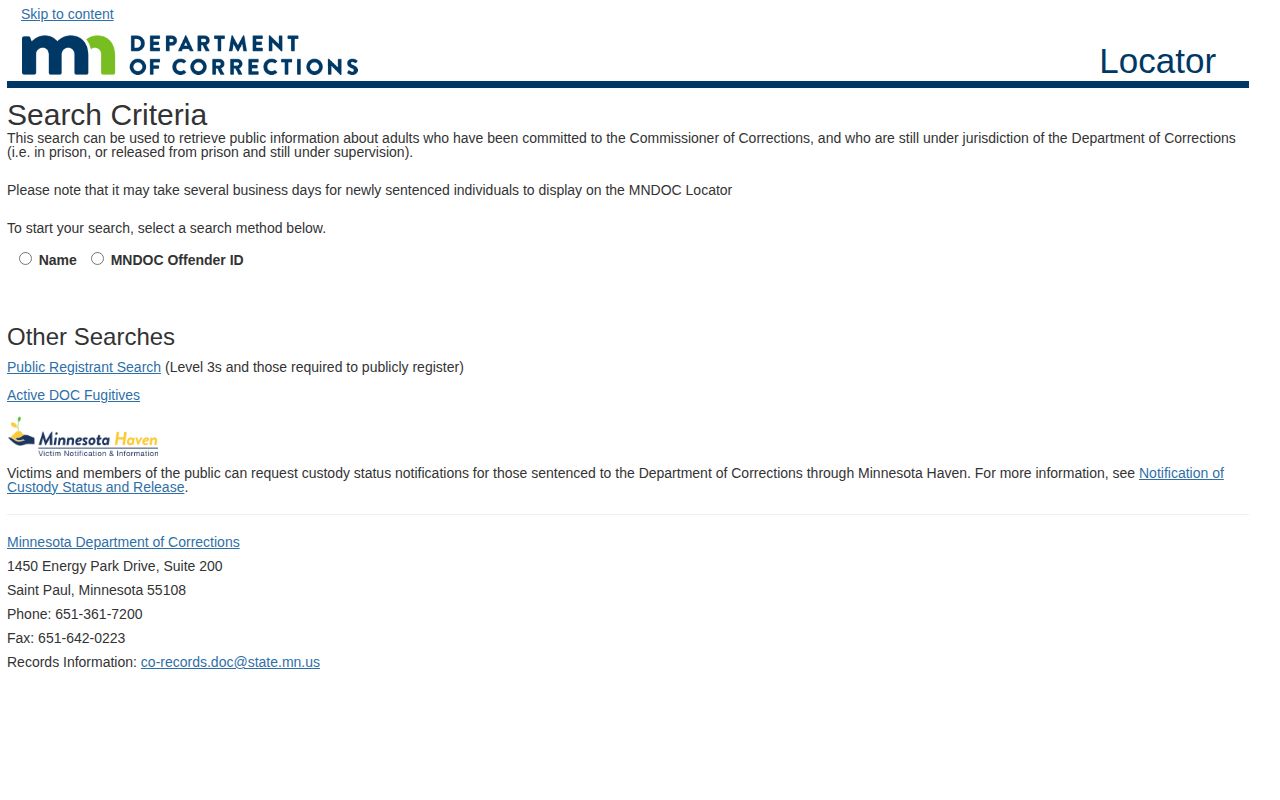
The interface begins the lookup. A matching details record and the Murray court sentence supply the identity and date context.
Interface fields can change, so copy the labels displayed on the live record rather than promising a fixed layout. DOC materials identify a core set of details that can support release verification.
| Field | Use in a Murray release check | Limit |
|---|---|---|
| OID | Links the search to one DOC record | Does not replace identity comparison |
| Current status | Distinguishes prison from a community placement when stated | May not explain every other case or hold |
| Location or supervision | Points to the institution or field-office route | Office location is not a home address |
| Offense and case | Connects DOC custody to the Murray judgment | Must be compared with the court record |
| Sentence date fields | Shows computed milestones under their exact labels | A projected date is not an actual exit |
For a detailed explanation, the viewer directs users to the appropriate correctional facility or Central Records at co-records.doc@state.mn.us. Preserve the date and time of the search because status and facility assignment can change.
Note: Save the exact status, location, date labels, and search time before asking DOC to explain an apparent conflict.
Minnesota DOC Release Versus Discharge
Supervised release means the incarceration portion of an executed sentence has ended and the person serves the remaining portion in the community under corrections authority. It is a physical prison release but not a final discharge. Conditional release is a separate statutory term for specified offenses and may extend beyond ordinary supervised release. Parole chiefly concerns life, indeterminate, and other cases within the Minnesota Supervised Release Board's defined authority.
A final discharge or expiration ends DOC jurisdiction over that sentence, subject to other cases or legal obligations. Because Public Viewer is jurisdiction-based, a fully discharged person may no longer appear. Central Records and the Murray court file then become the better historical sources.
- Confinement release
- The end of secure prison confinement under the stated DOC date or event.
- Supervised release
- The community portion of an executed determinate prison sentence.
- Conditional release
- An additional statutory community term for specified offenses.
- Discharge
- The formal end of DOC authority over the sentence.
A person on supervised release may be routed through the DOC field office that serves the county. Murray County is assigned to the Marshall office. That routing does not prove where the person lives, and supervision files can contain nonpublic details.
Minnesota DOC Murray Release Dates
Date labels must remain distinct. A projected release date is a planning estimate. A Confinement Release Date is a term used in DOC and Board materials for an incarceration endpoint. A Parole Eligibility Date is the first point at which a Board-controlled person may be considered, not a promised exit. A termination or expiration date can mark the sentence or jurisdiction endpoint rather than the prison-door date.
For ordinary crimes committed on or after August 1, 1993, Minnesota Statutes section 244.01 describes a two-thirds term of imprisonment. Section 244.05 supplies the one-third supervised-release portion, less disciplinary confinement. Minnesota's general model is therefore not the often repeated 85-percent rule.
Modern earned incentive release credit can reduce eligible imprisonment within statutory limits. It cannot be subtracted automatically. Eligibility exclusions, jail credit, consecutive or concurrent terms, discipline, conditional release, Board action, and court changes can alter an individual computation. The Murray release-date lookup explains those Minnesota rules without offering an unsourced calculator.
Note: Use the exact live label and DOC calculation; never turn an eligibility or projected date into a statement that release occurred.
Murray Jail to Minnesota DOC
A Murray County Jail booking can end with commitment to DOC after an executed sentence. Murray's local jail-administration description includes arranging movement to state prison or a contracted jail. That closed booking is a transfer from local detention into state custody, not release to the community.
Pair the sending and receiving records. Murray's admission and release entry should identify the transfer authority and destination. The Murray court judgment supplies the executed sentence. Public Viewer should then show the in-scope DOC record, current institution, or later community-supervision status. If the person first boarded in Lyon, Lyon's transport entry may form the link between the court judgment and DOC acceptance.
A transfer among DOC prisons later follows the same principle. The facility name changes while DOC jurisdiction and secure confinement continue. Actual prison release should be confirmed by a community status or completed release event, not by disappearance from one institution's location field.
Minnesota DOC Records and Contact
Use the DOC data-request process for public sentence, status, release, and discharge information that the viewer does not explain. Identify the person by full name and OID. Ask for the final release or discharge date, event type, public supervision dates, and existing sentence-computation fields. DOC need not create or rearrange data that it does not maintain.
The central office is the stable agency contact. Central Records handles status and sentence questions by email. A current facility may also explain the live record. Public counter hours or facility-specific contact procedures should be verified on DOC's site before an in-person visit.
Minnesota Department of Corrections
Central Office
1450 Energy Park Drive
St. Paul, MN 55108
651-361-7200
Central Records: co-records.doc@state.mn.us
Hours and in-person access: verify with DOC.
Chapter 13 allows access to public government data in a prompt and reasonable manner, subject to other classifications. Ask for a cost estimate before copies. No fixed response period or fee should be assumed for an individual DOC request.
Minnesota DOC Murray Follow-Up
Minnesota Haven is the DOC custody and status notification path for eligible registrations involving people sentenced to the Commissioner. It is distinct from Minnesota VINE, which covers county-jail release and custody events. The DOC notification page explains both routes. Moving from Murray jail to DOC changes which system applies.
After prison release, the Public Viewer may identify a supervision location. The official DOC contact table routes Murray County to the Marshall field office at 601 Highway 59 N in Marshall, 507-476-4330. Office staff can route a status question but may not disclose an agent, address, schedule, conditions, or nonpublic case notes.
Use the Murray County District Court file to confirm the committing case, sentence, and later court events. Court records do not prove the exact time of physical prison exit. DOC status and Central Records remain the source for that correctional event.
Note: Minnesota VINE follows county-jail events, while Minnesota Haven serves qualifying DOC notifications after a commitment to the Commissioner.
Minnesota DOC Record Boundaries
Minnesota Statutes section 13.85 classifies corrections and detention data. Medical, psychological, financial, unrelated personal, institutional-security, informant, investigative, and safety-sensitive data can be private or confidential. The availability of status and sentence fields does not open a complete prison or supervision file.
Juvenile and sealed records also have access limits. Expungement can seal court and related executive records according to the order or statute. A data request cannot be used to evade those restrictions. When an official record is unavailable, report that limit rather than importing an unverified copy.
Minnesota Statutes section 299C.14 requires specified release officials to report identification, service, and discharge information to the BCA. That duty supports official release reporting but does not turn all BCA data into a public historical locator. For a finally discharged Murray person, request the public record from DOC Central Records and compare it with the court case.