
Murray Projected and Actual Release Dates
A projected release date is a planning estimate based on the sentence calculation and facts known at that point. It can move. An actual release date records an event that has occurred. Even an actual exit from one facility needs a destination: release to the community, transfer to Lyon County Jail, commitment to a Minnesota state prison, or a handoff to another authority do not mean the same thing.
Pretrial detention has no sentence-based release date. A Murray County defendant may leave after posting bond, a judge changing conditions, a dismissal, or final disposition. The Murray County District Court case explains the legal event. The jail that physically held the person supplies the admission and release entry. Murray County also boards people at Lyon County, so both custody records may be needed.
A sentenced state prisoner follows the DOC computation, while a local jail sentence follows the court judgment and jail calculation. The label matters. “Confinement Release Date,” “Parole Eligibility Date,” “termination,” “expiration,” and “actual discharge” each describe a different point.
Find Murray County Release Dates
Classify the custody before searching. The Minnesota DOC Public Viewer is the main online route for adults committed to the Commissioner who remain under DOC jurisdiction. It is not the Murray County Jail roster and does not cover every county-only case. A person released from prison but still supervised may remain in the viewer, while a person finally discharged from DOC authority may later fall outside its scope.
- Check the Murray court case to identify pretrial status, a local jail sentence, or an executed DOC prison commitment.
- For a county case, ask the jail that physically holds the person for its current sentence computation, holds, and release status.
- For a state commitment, search Public Viewer by OID when possible. Otherwise, use the full name and compare identity details.
- Open the correct DOC result and record each status, location, offense, sentence, and date label exactly as shown.
- Cross-check the committing county and court file. Ask DOC Central Records to explain a date or sentence calculation that is unclear.
- On the expected day, confirm actual release with the jail or DOC. Use a notification service only as an alert, not the final record.
The Murray County release search and records overview provides the broader path when it is not yet clear which agency held the person. Keep the OID, booking number, and court file number separate. They identify different records.
Minnesota DOC Release Date Fields
The Public Viewer details screen should be read on the day of the lookup because field labels and scope can change. DOC instructs users to record the OID, current status, location or supervision information, offense and case entries, and date labels. A community-supervision status can prove that secure state imprisonment ended while DOC jurisdiction continues. It does not show that all warrants, court cases, or restrictions have ended.
The live DOC search is shown at the official Public Viewer source.
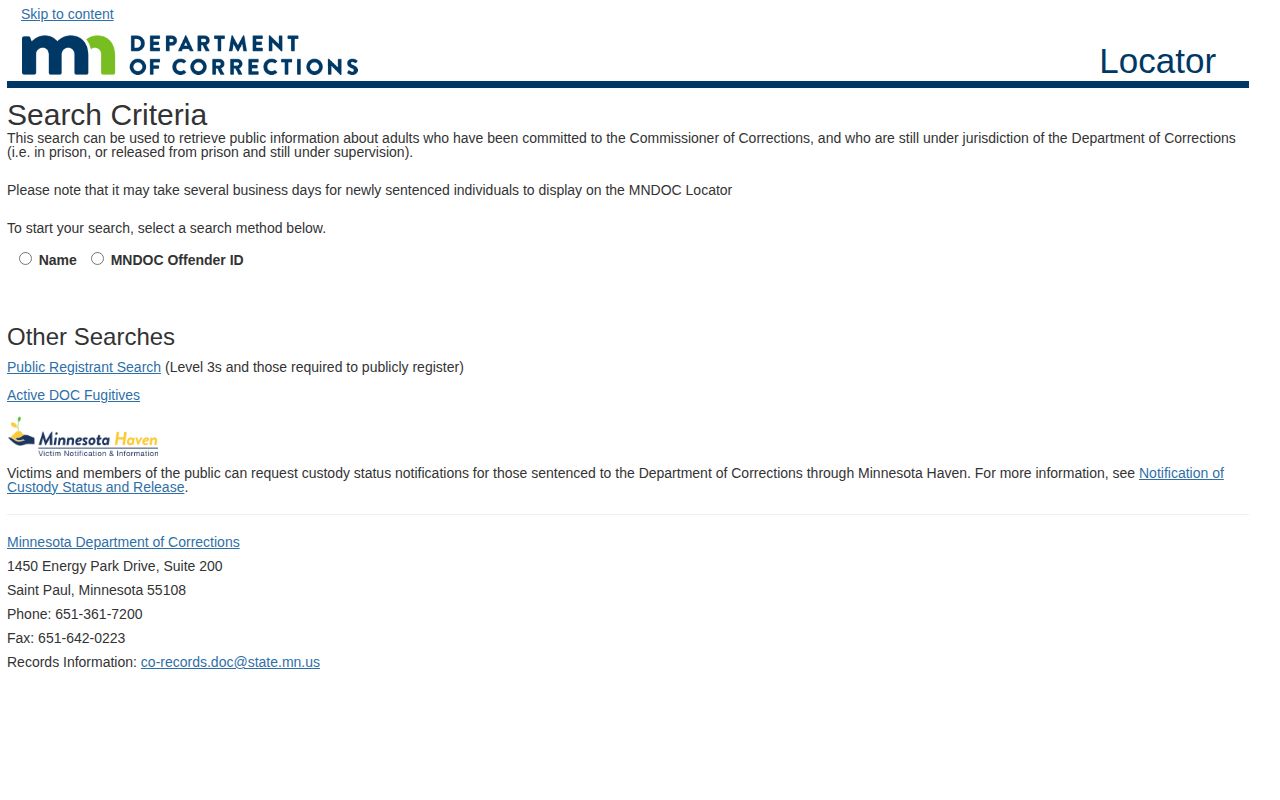
The screen is an entry point. A matching details record, the Murray court sentence, and agency confirmation supply the date context.
| Date or field | Meaning | What it does not prove |
|---|---|---|
| Projected release date | A planning estimate that may change | That release occurred |
| Confinement Release Date | A DOC term used for the incarceration endpoint in Board materials | Final discharge from all authority |
| Parole Eligibility Date | The first possible Board consideration point in a covered case | A promised exit date |
| Termination or expiration | A sentence or jurisdiction endpoint | The exact prison-door date |
| Actual release or discharge | A completed historical event | That no other jurisdiction has custody |
Note: A no-result can reflect identity mismatch, a county-only case, final discharge, nonpublic limits, or timing rather than no prior custody.
Murray Release Date Credit Rules
Minnesota's general determinate prison framework is not the national “serve 85 percent” formula often repeated online. For crimes committed on or after August 1, 1993, Minnesota Statutes section 244.01, subdivision 8 defines the term of imprisonment as two-thirds of the executed sentence. Section 244.05, subdivision 1b describes the supervised-release portion as one-third of the fixed sentence, less disciplinary confinement. That baseline addresses a state-prison sentence, not a pretrial Murray County jail stay.
The Minnesota Rehabilitation and Reinvestment Act creates earned incentive release credit for an eligible incarcerated person. Section 244.44 permits earned credit to reduce imprisonment by up to 17 percent of the total executed sentence, but not below one-half. The credit does not enlarge the supervised-release term, may be revoked for facility-rule violations or criminal acts while incarcerated, and cannot be assumed for every case.
Eligibility exclusions in section 244.45 include life sentences, specified old indeterminate sentences, and people subject to old good-time law or similar laws. Offense dates also matter. Historic sentences may use a prior framework. Only the DOC sentence computation shows whether a specific person qualified and what credit was actually awarded.
A simple example shows why arithmetic is only a starting point. Under the traditional post-1993 baseline, a hypothetical 36-month executed sentence divides into 24 months of imprisonment and 12 months of supervised release. That is not a Murray County date calculation. Jail credit, concurrent or consecutive terms, disciplinary confinement, earned-credit eligibility and award, conditional release, and later court orders can all change the dates. Life and indeterminate cases may depend on an eligibility date and Board review instead. Older good-time law can also apply to historic offenses. The safe result is the date and label produced by DOC for the specific sentence, supported by the judgment and an agency explanation when needed.
Murray Weekend Release Date Rules
Minnesota's weekend and holiday statute has an offense-date split. Under section 244.05, subdivision 1a, a state-prison release scheduled for Friday, a weekend, or a holiday moves to the prior qualifying day for crimes before August 1, 1992. For crimes on or after that date, it moves to the first qualifying day after the scheduled date. This is a statutory state-prison rule, and it should not be copied onto a Murray County jail sentence.
The shift can make a calendar estimate look wrong even when the agency applies the statute correctly. Offense date, not the date someone happens to check the record, determines which direction applies. A Parole Eligibility Date or Board meeting date is also not converted into a physical release merely because it falls near a weekend.
Ask which date field moved and why. DOC Central Records can explain a state sentence computation. The holding jail must explain its local release calculation. Keeping those agencies separate prevents a state-prison timing rule from being used as an unsupported Murray jail promise.
Murray Jail Release Date Limits
A Murray County jail term can involve judicial jail credit, a local sentence, good-time records, work release, a stayed term, and holds from other authorities. Murray's jail-administration position description confirms that the jail maintains good-time and discharge records. The research found no public Murray handbook or formula that supports an independent date calculation.
The judge's pronounced term is only one input. Ask the jail administrator for the existing sentence computation and good-time ledger, and compare them with the filed sentencing order. If Lyon County Jail physically holds the person for Murray County, ask which agency maintains the operative daily custody and release entry. A closed Murray booking can mark a transfer rather than freedom.
Pretrial detainees need a different answer. Bond, a new court order, dismissal, another case, or a detainer can control release. Murray County District Court supplies current court contacts, and MCRO can show public case activity. The court explains legal authority; the jail confirms the physical exit.
Note: Use the court order and the holding jail's ledger together; neither source alone always gives the complete physical-release result.
Why Murray Release Dates Change
A projected date changes when the facts used in the sentence computation change or when another lawful authority prevents the planned exit. The effect depends on the custody type. A county-jail hold is not resolved by a state DOC estimate, and a Board action does not govern an ordinary local sentence.
| Factor | Possible effect | Where to verify |
|---|---|---|
| Earned incentive credit | May reduce eligible state imprisonment within statutory limits | DOC sentence computation |
| Disciplinary confinement or lost credit | Can move the secure-custody endpoint later | DOC or holding facility record |
| Jail credit or sentence correction | Changes time credited or the controlling term | Court order and agency calculation |
| Consecutive or concurrent terms | Changes how multiple sentences combine | Judgment and DOC Central Records |
| Warrant, detainer, or hold | May cause transfer or continued custody on another matter | Holding agency and issuing authority |
| Board decision or directive | May grant planning, deny release, or continue review in a covered case | Approved Board minutes and DOC record |
A detainer is a request or notice from another authority concerning custody. It can turn an apparent release date into a transfer date. The final record should say where the person went. “Not shown here” and “released to the community” are not interchangeable findings.
Confirm Murray Release Dates
Use alerts before the expected event, then use agency records afterward. Minnesota VINE covers county-jail custody changes and release notices for a specific Murray or Lyon record. Minnesota Haven is the separate DOC notification route for people sentenced to the Commissioner. The Murray County VINE inmate check explains county-jail registration and its limits.
Notifications depend on data sent by the participating agency. They may describe release, transfer, or another custody change and may not remain as a permanent archive. For a county-jail event, ask the jail for the admission and release record with the date, time, reason, and destination. For a state-prison event, compare Public Viewer with DOC Central Records. For a Board-controlled case, use approved minutes rather than an agenda's possible-outcome column.
Create a short verification log: time searched, identifiers used, system, exact status, agency timestamp, and next source checked. If two records conflict, do not choose the newer-looking screen without asking which agency maintains the operative custody record. Report each dated observation until the discrepancy is resolved.